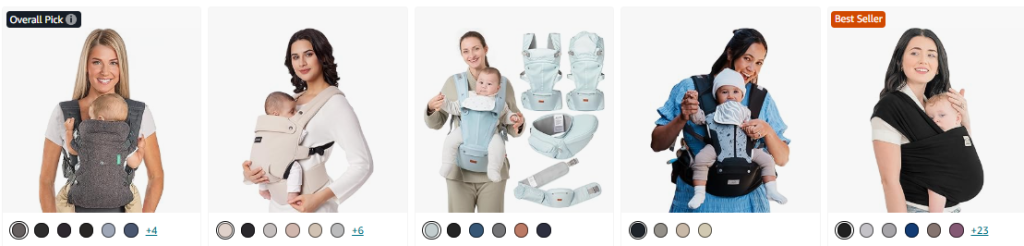
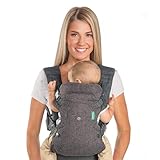
Looking for the best Baby Carrier? We've handpicked the top-rated, best-selling options available on Amazon right now. Whether you're comparing sizes or searching for the perfect fit, these picks are loved by thousands of happy customers.
* As an Amazon Associate I earn from qualifying purchases.
👶 Choosing the right baby carrier can feel overwhelming — newborn vs structured, wrap vs sling, XS vs L — the options are endless. This complete baby carrier size chart breaks down every carrier type, weight limit, age range, and sizing guide so you can carry your little one safely and comfortably from day one.
Baby Carrier Size Chart by Type — Complete Guide (2026)
Not all baby carriers are sized the same way. Some are sized by baby’s weight and age, while others are sized by parent’s body size. The table below gives you a quick overview of every major carrier type with their key measurements:
Carrier Type
Baby Age
Baby Weight
Parent Size
Carry Positions
Difficulty
Newborn Carrier
0 – 4 months
5 – 20 lbs (2.3 – 9 kg)
XS / S
Front only
Easy
Structured SSC
4 months – 3 yrs
15 – 45 lbs (7 – 20 kg)
XS / S / M / L
Front, Hip, Back
Easy
Stretchy Wrap
0 – 6 months
5 – 18 lbs (2.3 – 8 kg)
Size 2 – 6
Front only
Moderate
Woven Wrap
Newborn – 3+ yrs
5 – 45 lbs (2.3 – 20 kg)
Size 2 – 8
Front, Hip, Back
Advanced
Mei Tai
3 months – 3 yrs
10 – 40 lbs (4.5 – 18 kg)
One size (ties)
Front & Back
Moderate
Ring Sling
Newborn – 2+ yrs
5 – 35 lbs (2.3 – 16 kg)
XS / S / M / L / XL
Hip, Front, Cradle
Moderate
💡 Quick Rule: If your baby is under 4 months, focus on carriers specifically rated for newborns. If your baby can sit independently, almost any carrier type will work — it’s then about your comfort and lifestyle.
Soft Structured Carriers (SSC) like Ergobaby, Lillebaby, and Tula are sized by the wearer’s torso and body size — not the baby’s size. Use this chart to find your carrier size:
Carrier Size
Parent Clothing Size
Parent Waist (inches)
Parent Torso Height
Baby Weight Range
XS
US 0–2 / UK 4–6
24″ – 28″
Short (under 5’3″)
15 – 25 lbs
S
US 4–6 / UK 8–10
27″ – 32″
Average (5’2″ – 5’6″)
15 – 35 lbs
M
US 8–12 / UK 12–16
30″ – 38″
Average (5’4″ – 5’9″)
15 – 45 lbs
L
US 14–18 / UK 18–22
36″ – 46″
Tall (5’8″+)
15 – 45 lbs
XL / Plus
US 20+ / UK 24+
44″ – 56″
All heights
15 – 45 lbs
⚠️ Important: If you are between two sizes, always size up for a structured carrier — a looser fit can be adjusted with the straps, but a carrier that’s too small cannot be extended.
Wrap & Ring Sling Size Chart
Wraps and ring slings are sized very differently from structured carriers. Here’s how to find the right size:
Stretchy & Woven Wrap Sizes
Wrap Size
Length (metres)
Parent Clothing Size
Best Carry Style
Size 2
2.7 m (106″)
XS (US 0–2)
Pocket wrap cross carry
Size 3
3.2 m (126″)
S (US 4–6)
Simple hip carry
Size 4
3.6 m (142″)
S–M (US 6–8)
Front wrap cross carry
Size 5
4.2 m (165″)
M–L (US 10–14)
Front wrap cross carry
Size 6
4.6 m (181″)
L–XL (US 14–18)
Front wrap cross carry
Size 7
5.2 m (205″)
XL–2XL (US 18–22)
Double hammock back carry
Size 8
5.6 m (220″)
2XL+ (US 22+)
Double hammock back carry
Ring Sling Size Chart
Sling Size
UK Dress Size
US Dress Size
Shoulder / Chest Size
Sling Length (approx)
XS
6 – 8
2 – 4
Under 34″
~1.8 m
S
8 – 10
4 – 6
34″ – 36″
~1.9 m
M
10 – 14
6 – 10
36″ – 42″
~2.1 m
L
14 – 18
10 – 14
42″ – 48″
~2.3 m
XL
18 – 22
14 – 18
48″ – 56″
~2.5 m
💡 Ring Sling Tip: When in doubt between two ring sling sizes, always size up. Extra fabric can be tucked and adjusted easily — a sling that’s too short cannot be fixed.
How to Measure for the Right Baby Carrier Size
Getting the right fit requires two key measurements — your body measurements and your baby’s current weight. Follow these steps:
01
Weigh Your Baby
Check baby’s current weight at their last health visitor appointment. Weight determines which carrier types are safe.
02
Measure Your Waist
For structured SSCs, measure around your natural waist (just above hips). This determines waistband size.
03
Measure Your Torso
From shoulder to hip. Short torso (<16″) = XS/S panel. Average torso (16″–19″) = M panel. Long torso (>19″) = L panel.
04
Check Age Range
Some carriers need baby to have head control (around 4 months). Always verify age/weight minimums in the manual.
Safe Babywearing: The TICKS Rule
Regardless of which carrier you choose, always follow the internationally recognised TICKS safety guidelines:
T — Tight: The carrier should be tight enough that baby cannot slump. Snug like a hug.
I — In view at all times: You should always be able to see baby’s face by looking down.
C — Close enough to kiss: Baby should be high enough that you can kiss their head without bending.
K — Keep chin off chest: Baby’s chin should never be pressed to their chest — this restricts breathing.
S — Supported back: Baby’s back should be supported in its natural curved position. No slumping.
⚠️ Never use a baby carrier if: your baby was premature or has breathing difficulties, your baby has low muscle tone, or if the carrier shows any signs of damage, fraying, or broken buckles.
Baby Carrier Size FAQ
What size baby carrier do I need for a newborn? +
For a newborn (0–4 months), you need either a dedicated newborn carrier, a stretchy wrap, or a structured SSC with a newborn insert. The carrier size refers to the parent’s size — not the baby’s. Most newborn-specific carriers come in one adjustable size that fits parents from XS to XL. The key requirement is that the carrier supports the M-position (knees higher than bottom) and keeps baby’s chin off their chest.
How do I know if my baby carrier fits correctly? +
A correctly fitted baby carrier will: (1) hold baby high enough to kiss their head, (2) keep baby’s knees higher than their bottom in an M-position, (3) have baby’s back in a natural curved position — not flat or slumped, (4) feel snug but not tight on your body — the waistband should sit at or just below your belly button, and (5) distribute baby’s weight across your hips and shoulders evenly without strain on your lower back.
Can I use the same carrier for a newborn and a toddler? +
Yes — some carriers are designed to grow with your baby. Woven wraps can be used from newborn to toddler. Many structured SSCs offer a newborn insert for the early months and then work without the insert from 4 months onwards up to 3 years or 45 lbs. Check the manufacturer’s age and weight limits carefully. If your toddler exceeds the weight limit, stop using the carrier even if they are still young in age.
Is baby carrier sizing based on the baby or the parent? +
It depends on the carrier type. Structured SSCs (like Ergobaby or Tula) are sized by the parent’s body — specifically waist circumference and torso height. Ring slings are sized by the parent’s shoulder/clothing size. Wraps are sized by length, which relates to the parent’s size. The baby’s weight and age determine which carrier types are safe to use, but the actual size label on the carrier refers to the parent’s measurements.
What is the weight limit for baby carriers? +
Weight limits vary by carrier type and brand. Most structured SSCs support babies from 15 lbs (with newborn insert from 7 lbs) up to 45 lbs (around 3–4 years). Woven wraps typically support up to 45 lbs as well. Ring slings usually support up to 35 lbs. Stretchy wraps are typically rated up to 18–20 lbs due to the fabric losing supportive tension beyond that weight. Always check the specific brand’s maximum weight limit.
What is the best baby carrier for a plus-size parent? +
Many brands now offer extended sizing (XL and Plus size) for structured SSCs. Look for carriers with waistbands that extend to at least 52″–60″. Brands like Ergobaby, LÍLLÉbaby, and Tula all offer plus-size options. Mei Tai carriers and woven wraps are naturally accommodating as they use tie straps rather than buckles and can be adjusted for any body size. Ring slings in size XL or XXL also work very well for larger body types.
Can both parents use the same baby carrier? +
Yes — most structured SSCs can be adjusted to fit two different sized wearers. The waistband and shoulder straps are adjustable. However, if the two parents are very different sizes (e.g., XS and XL), it may be worth purchasing a carrier in each person’s preferred size, or choosing a carrier with a very wide adjustment range. Mei Tai and wrap carriers are the most easily shareable as they have no fixed buckle sizing.
When should I stop using a baby carrier? +
You should stop using a carrier when: (1) your baby exceeds the carrier’s maximum weight limit, (2) your baby’s head no longer fits within the carrier’s panel, (3) the carrier shows any damage, fraying, or broken hardware, or (4) carrying becomes uncomfortable for you despite proper adjustment. Most children outgrow the desire to be carried between ages 2–4, though many parents continue back carrying toddlers up to 4–5 years old with appropriate carriers.